Let’s get technical.
Everything your team might ask in the first meeting.

Meet the PT-3. |
|
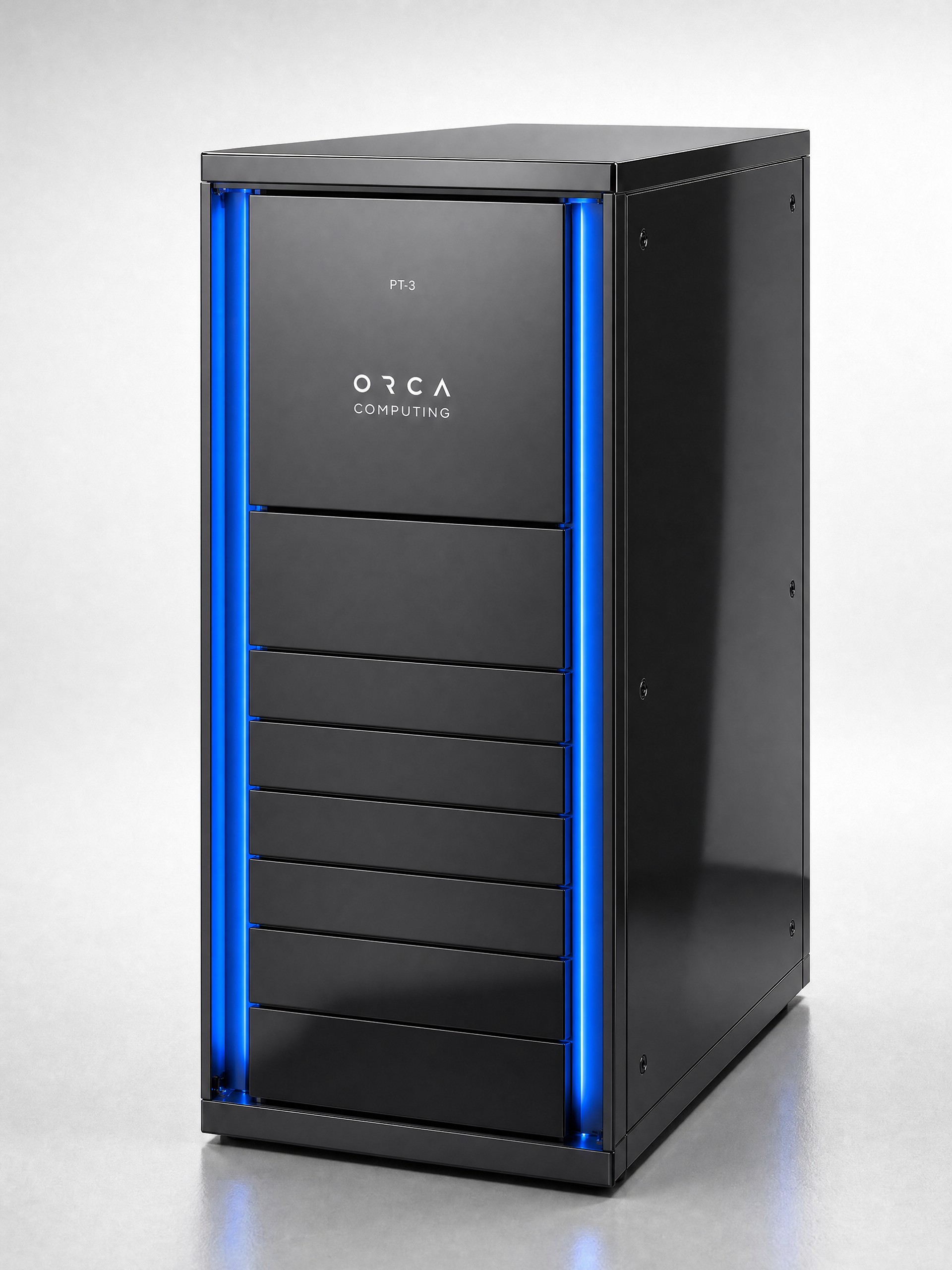
A pioneering photonic approach means far fewer components, providing a system that can install into a standard data centre at room temperature, with no facility modifications.

Connect today to explore our extensive Python library with example quantum algorithms, and hybrid quantum-classical workflows. Integrate with your machine learning frameworks like PyTorch. Test on state-of-the-art simulation backends, and optimise algorithms before deploying them on actual quantum hardware.

Everything your team might ask in the first meeting.
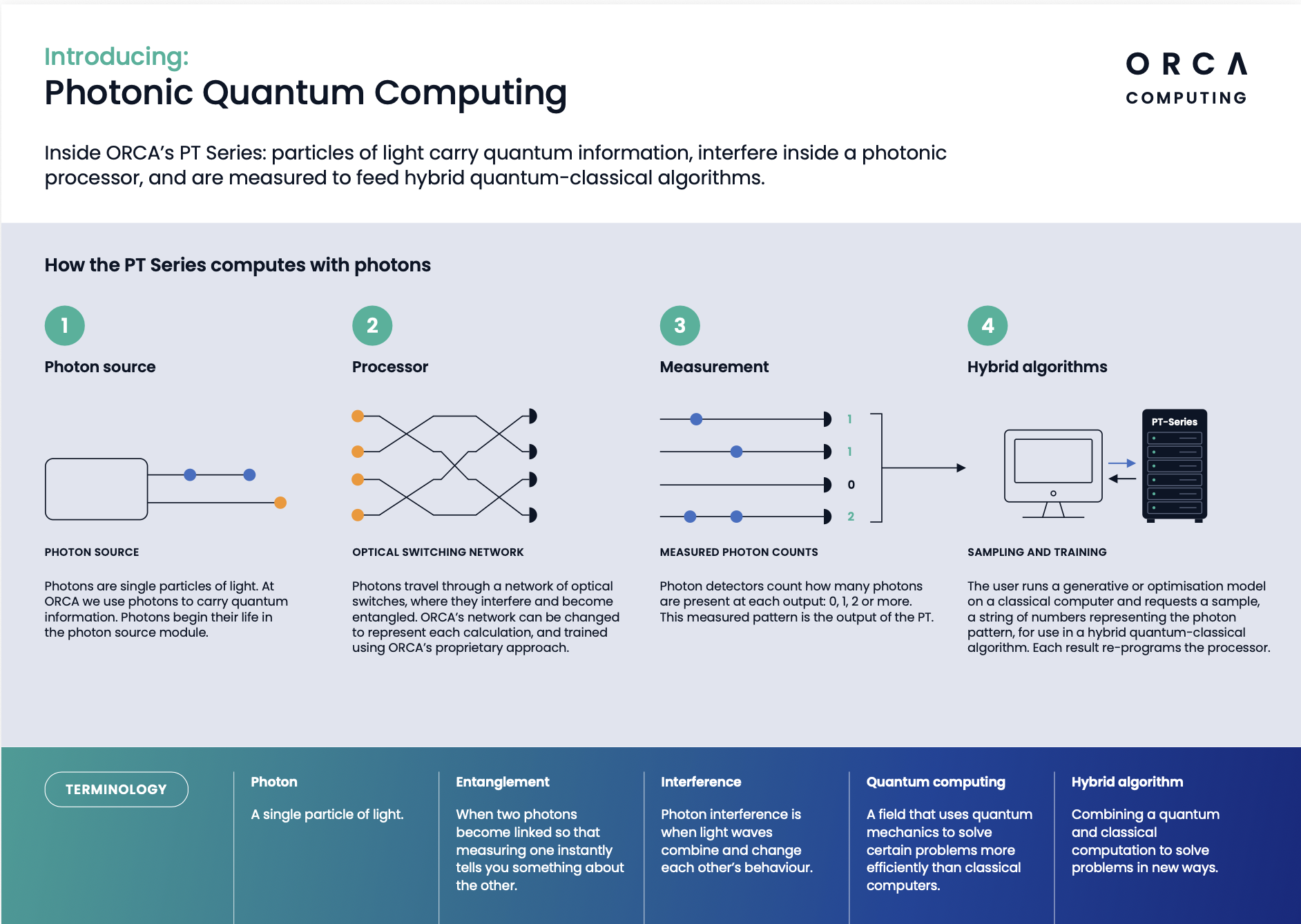
How computing with light works. |
|
| Click the infographic for a quick explainer on our breakthrough photonic architecture. |
Digital Realty Innovation Lab · London
See ORCA’s PT-3 running alongside GPU workloads in production-grade AI infrastructure. Register for one of our events, book a private demo or join a 3D virtual tour at Digital Realty’s Innovation Lab.
Show me the PT-3
Highly successful first generation system that demonstrated the first ever end-to-end hybrid quantum-classical generative AI workflow in a data centre.
Data centre ready quantum acceleration of generative AI and optimisation workloads, with the industry’s first ever on-premises deployment to large enterprise.
Inflection point for broad industrial adoption of quantum computing delivering measurable commercial value to organisations.
Evolution in performance reaching large scale commercially viable quantum computing built on ORCA’s modular, scalable photonic architecture.
Talk to us about applying the PT-3 to your most demanding workloads.

David Hall DPhil
Head of Delivery
Prof. Ian Walmsley is Chairman of the ORCA Computing Board and a leading figure in quantum optics, quantum memories and waveguide circuits. He is Provost of Imperial College, London, an Honorary Fellow at St Hugh's College, Oxford and a Fellow of the Royal Society, The Optical Society, the Institute of Physics and the American Physical Society. Previously, he was President of the Optical Society of America, Pro-Vice-Chancellor for Research and Innovation, Hooke Professor of Experimental Physics at the University of Oxford and Director of the NQIT (Networked Quantum Information Technologies) hub. Prof. Walmsley is recognised for developing the SPIDER technique for characterising ultra-fast laser pulses.

Enhance renewable energy optimisation and accelerate the development of biofuels.
Investigating molecular structures is an important pursuit in computational chemistry, especially in fields likes biofuel formulation, material innovation, and pharmaceutical development where research acceleration is critical. The specific problem considered here is significant across the energy industry, as molecule’s possible structures directly determine many of its physical and chemical traits. However, the vast array of possible configurations and high computational requirements make it difficult for traditional methods to find low-energy conformations for certain molecules.
ORCA partnered has with bp to explore a hybrid quantum-classical approach using generative adversarial network (GAN) algorithms. This approach aims to generate low-energy conformations of small and medium size hydrocarbon molecules, offering a potential solution to the computational hurdles faced in molecular exploration.