Discover the drugs that your AI can’t
ORCA discusses a recent use case with Technical University of Denmark on quantum accelerated breakthroughs in peptide design.
20 mins presentation followed by live Q&A.
Recording sent to everyone who registers.

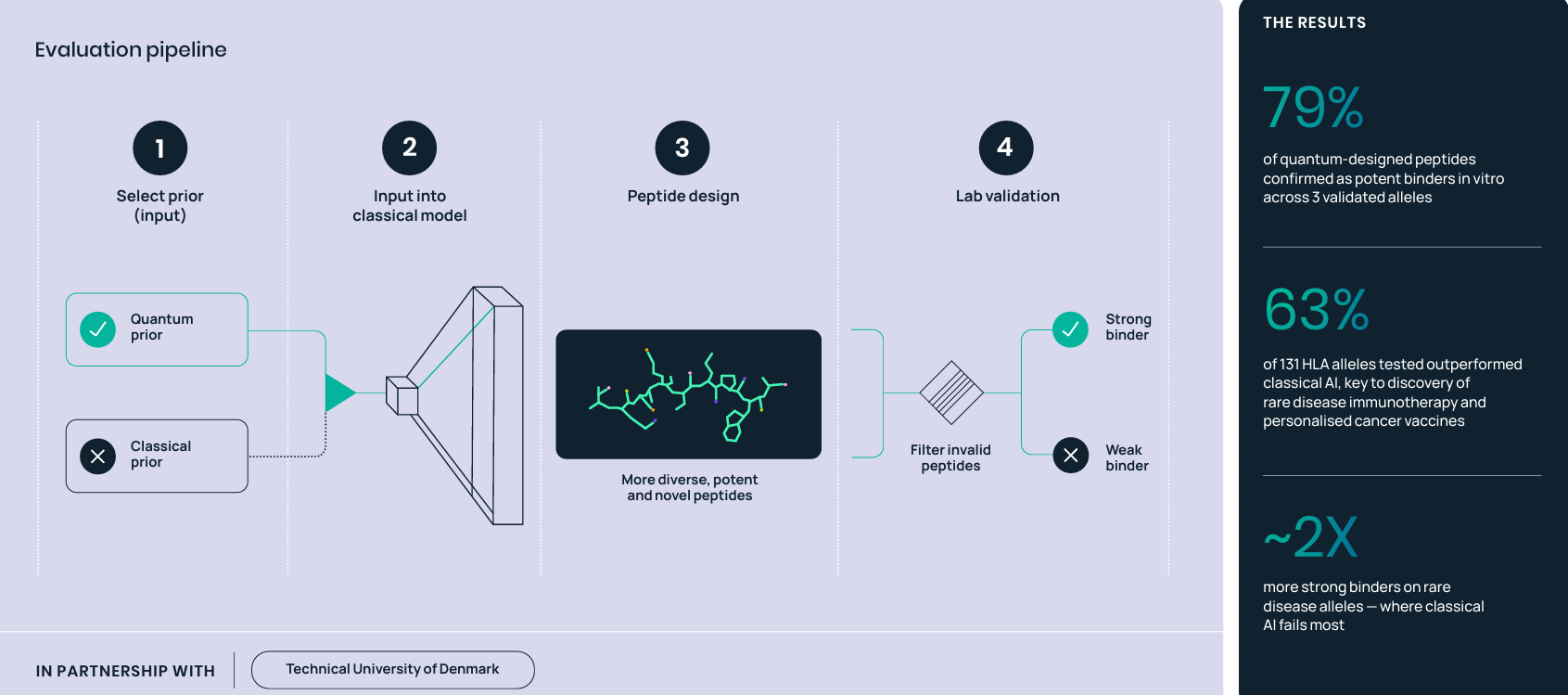
On the QM9 benchmark, ORCA's quantum prior increased the number of valid and unique molecules while also producing substantially more novel candidates outside the training dataset.
Advancing rare disease drug discovery and personalised cancer vaccines — quantum-accelerated generative AI finds the candidates classical models miss, validated in vitro across all tested alleles.
Every discovery programme hits the same constraint: the early screening funnel is too narrow. Classical generative models tend to concentrate around known chemical space, and the search for novel structures, molecules and functional materials becomes increasingly expensive or simply not feasible with classical compute alone.
Generative models are only as good as the prior they use, and classical priors are too simple. A photonic quantum accelerator samples from complex distributions and can explore more of the chemical space that matters, reaching beyond the limits of classical computing alone.
ORCA provides a practical, hybrid solution to the computational hurdles faced in molecular exploration. ORCA's photonic quantum accelerator works alongside your current classical workflow — same models, same training, same Python frameworks. Only the diversity and quality of what comes out change.
LIVE WEBINAR ⋅ 27 October · 12pm BST
ORCA discusses a recent use case with Technical University of Denmark on quantum accelerated breakthroughs in peptide design.
20 mins presentation followed by live Q&A.
Recording sent to everyone who registers.
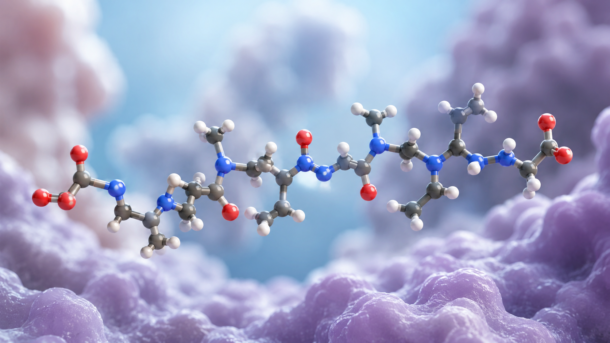
There is no bespoke quantum stack for your team to learn, and no separate discovery pipeline to maintain. The accelerator substitutes the prior your generative model samples from — everything downstream stays as it is.
Discuss a use case and lets tackle your hardest problems.

David Hall DPhil
Head of Delivery
Prof. Ian Walmsley is Chairman of the ORCA Computing Board and a leading figure in quantum optics, quantum memories and waveguide circuits. He is Provost of Imperial College, London, an Honorary Fellow at St Hugh's College, Oxford and a Fellow of the Royal Society, The Optical Society, the Institute of Physics and the American Physical Society. Previously, he was President of the Optical Society of America, Pro-Vice-Chancellor for Research and Innovation, Hooke Professor of Experimental Physics at the University of Oxford and Director of the NQIT (Networked Quantum Information Technologies) hub. Prof. Walmsley is recognised for developing the SPIDER technique for characterising ultra-fast laser pulses.

Enhance renewable energy optimisation and accelerate the development of biofuels.
Investigating molecular structures is an important pursuit in computational chemistry, especially in fields likes biofuel formulation, material innovation, and pharmaceutical development where research acceleration is critical. The specific problem considered here is significant across the energy industry, as molecule’s possible structures directly determine many of its physical and chemical traits. However, the vast array of possible configurations and high computational requirements make it difficult for traditional methods to find low-energy conformations for certain molecules.
ORCA partnered has with bp to explore a hybrid quantum-classical approach using generative adversarial network (GAN) algorithms. This approach aims to generate low-energy conformations of small and medium size hydrocarbon molecules, offering a potential solution to the computational hurdles faced in molecular exploration.